
History and heritage
Few breeds carry a heritage as purposeful as the Portuguese Water Dog. It was bred as a working courier on Portugal's fishing boats, pulling 200-foot nets through the water, retrieving anything that went overboard, and carrying messages and goods from ship to ship and ship to shore in the cold Atlantic. It is an exceptional swimmer and diver with a sturdy medium build, and a loyal companion and alert guard.
PWDs come in two coat types, curly or wavy, in black, brown, or either of those with white.
PWD At A Glance (AKC standard)
- Group: Working
- Males: 20 to 23 inches at the withers (ideal 22), 42 to 60 pounds
- Females: 17 to 21 inches at the withers (ideal 19), 35 to 50 pounds
- Build: a robust, muscular dog with strong, substantial bone, slightly longer than tall
- Coat: thick and profuse with no undercoat, in two varieties, curly or wavy, with no preference between them
- Colors: black, white, various browns, or black or brown with white
- Trims: the traditional lion clip or the retriever clip, always with the tip of the tail left full
- Head and expression: broad, domed skull, with a steady, penetrating and attentive expression
- Tail: thick at the base and not docked, used as a rudder in the water
- Gait: short, lively steps at a walk and a balanced, forward-striding trot
- Temperament: spirited, brave, intelligent and loyal. Shy, vicious or unsound temperament is a major fault
Read the full breed standard and profile at the AKC.
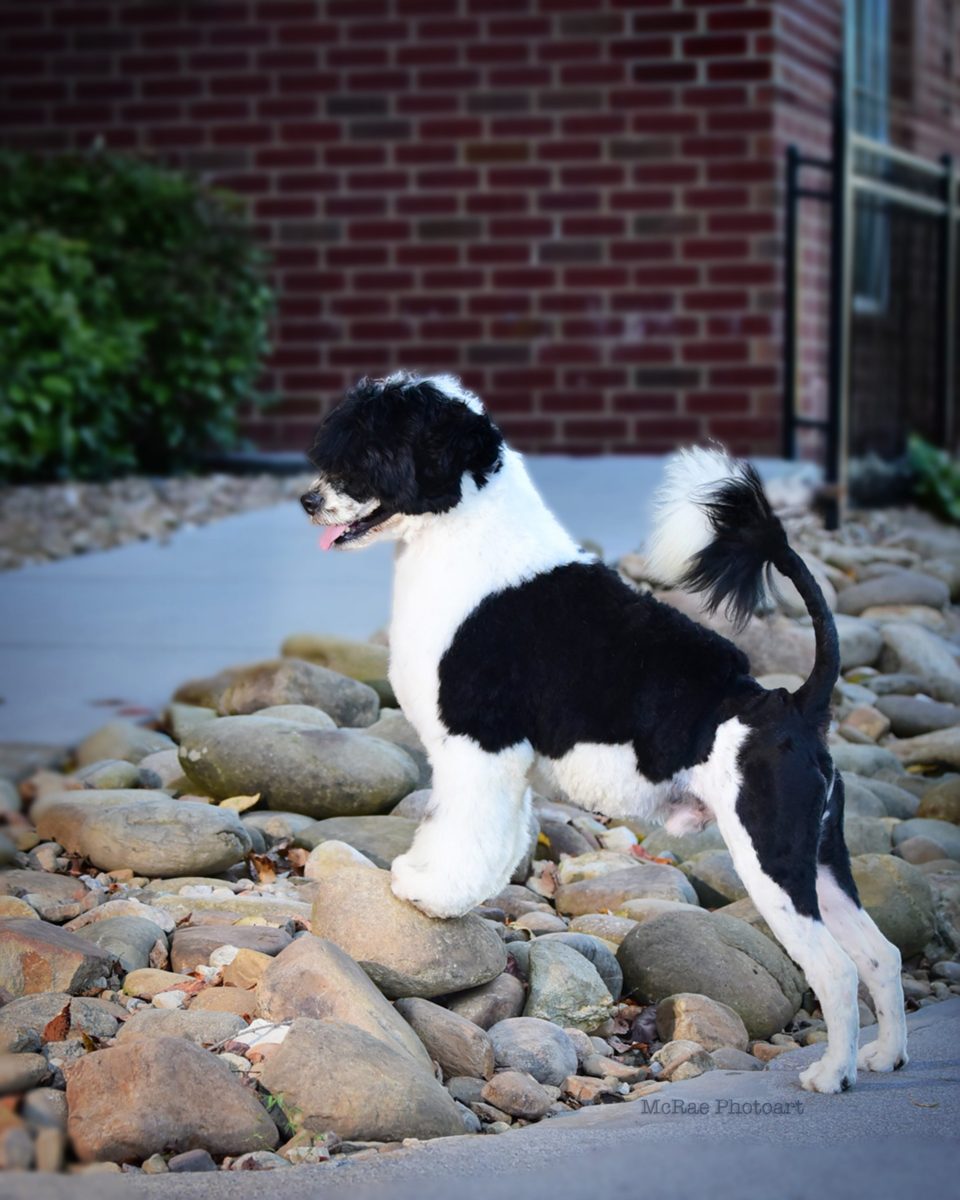 CH Allegiance Set In Stone, Brix, a black and white Portuguese Water Dog
Photo: McRae Photoart
Temperament and personality
The breed standard describes the Portuguese Water Dog as “an animal of spirited disposition, self-willed, brave, and very resistant to fatigue.” It goes on to call the breed exceptionally intelligent and a loyal companion that is happy to work with the people it knows and trusts. The standard also treats a shy, vicious or unsound temperament as a serious fault. That is the standard we hold our own dogs to.
PWDs are highly intelligent, learn quickly and are natural problem solvers. As a working breed they need a job and a clear, calm leader. Once a PWD understands the household hierarchy, life becomes remarkably harmonious. They are loyal, affectionate and thrive on being included in family life. They are also exuberant, independent thinkers who will challenge you, and they tend to counter-surf. Weekly brushing and regular grooming are part of the deal.
The mouthy breed: what families need to know
Because PWDs were bred to carry and retrieve, they are instinctively mouthier than most families expect. This matters most for families with young children. Teething, at about 3 to 5 months, is the sharpest stage. The number-one skill to teach from day one is the "trade": when a puppy starts mouthing, put an appropriate toy in their mouth to redirect them. With consistent training this is very manageable, and the same instinct makes them eager learners.
The mischievous side
A PWD with nothing to do will find something to do, and you may not like the choice. Here is the full picture, straight from our families.
 Scout Roge, South Carolina, a black Portuguese Water Dog, sitting among shredded paper
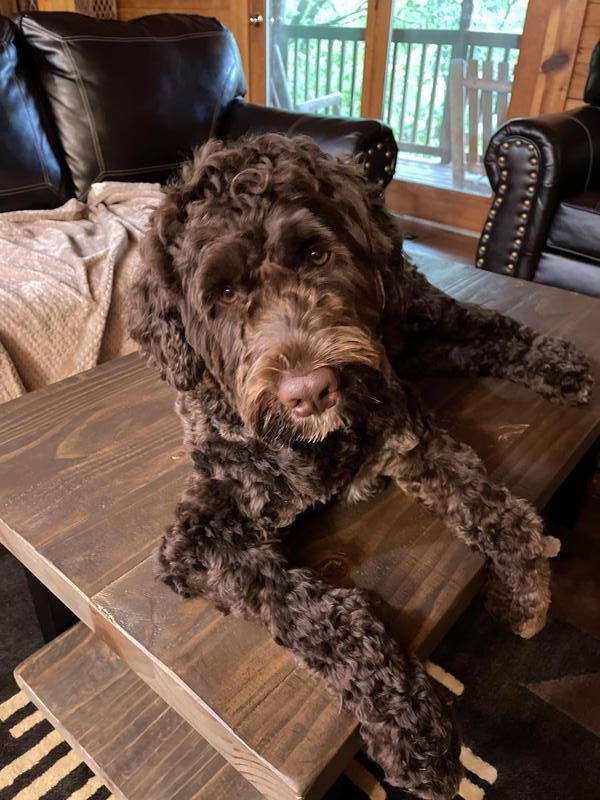 Kiwi Kempf, Illinois, a brown Portuguese Water Dog, lying on a coffee table
 Luna Zung, Illinois, a black Portuguese Water Dog puppy, standing in a flower pot
Energy, exercise and mental stimulation
PWDs are active dogs that suit busy families. They make great hiking and camping companions and are drawn to pools, lakes and rivers. They don't need extreme exercise: walks, fetch, play with children and swimming are plenty. Mental stimulation matters just as much, with puzzles, frozen Kongs, snuffle mats, hide-and-seek and scent games. A young PWD with the "zoomies" is usually under-stimulated mentally, or just needs a nap, like a cranky toddler.
A note on running. A PWD cannot be a running partner until about 15 to 18 months old. Growth plates must be fully closed before sustained pavement running. Until then, hiking, natural play and swimming are all appropriate. Too much high-impact running too early risks serious joint damage and early arthritis.
Socialization
PWDs want to be with their people, always. Once a puppy is fully vaccinated, get it out regularly to meet people, places, sounds and environments. A well-socialized PWD is a confident, adaptable companion for life.
 Two smiling girls sitting with a black Portuguese Water Dog puppy
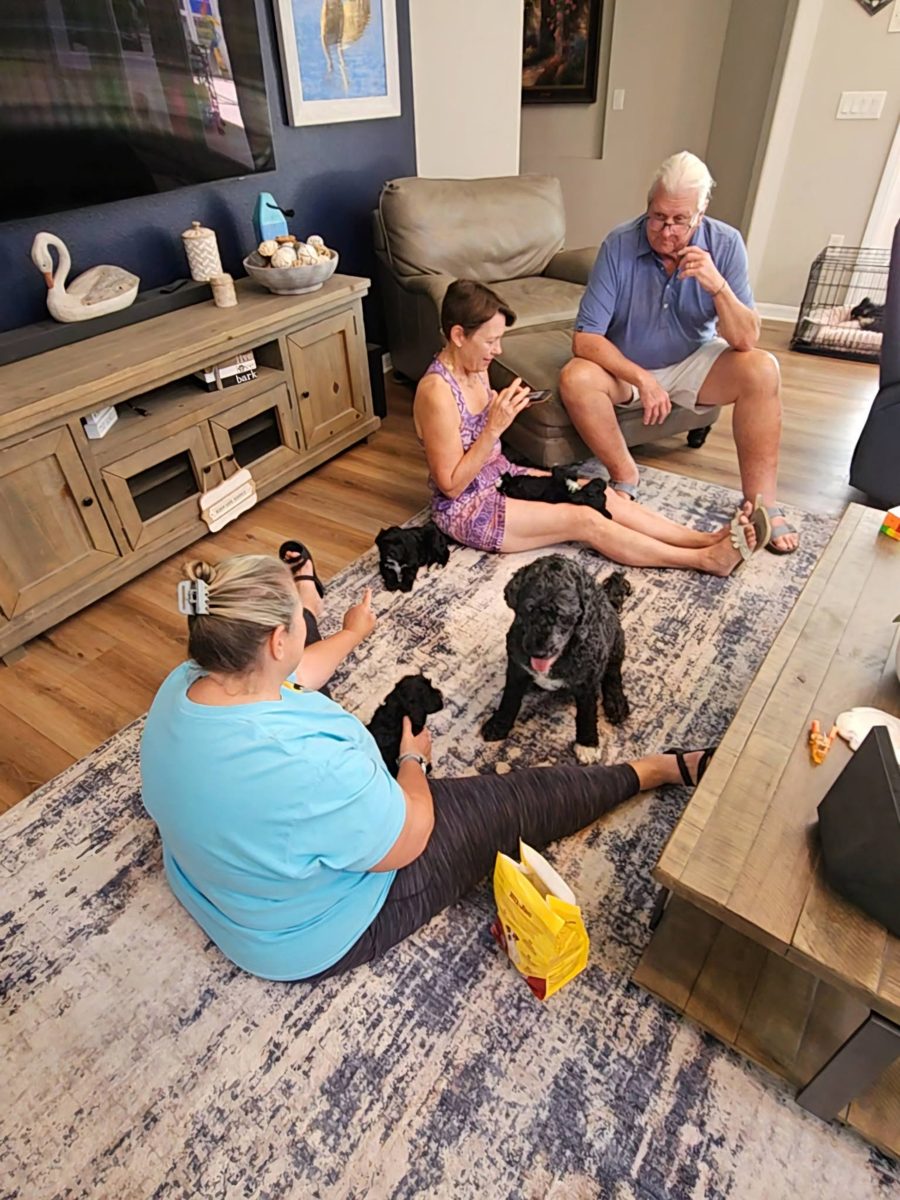 Visitors sitting on the floor with Portuguese Water Dog puppies and an adult PWD
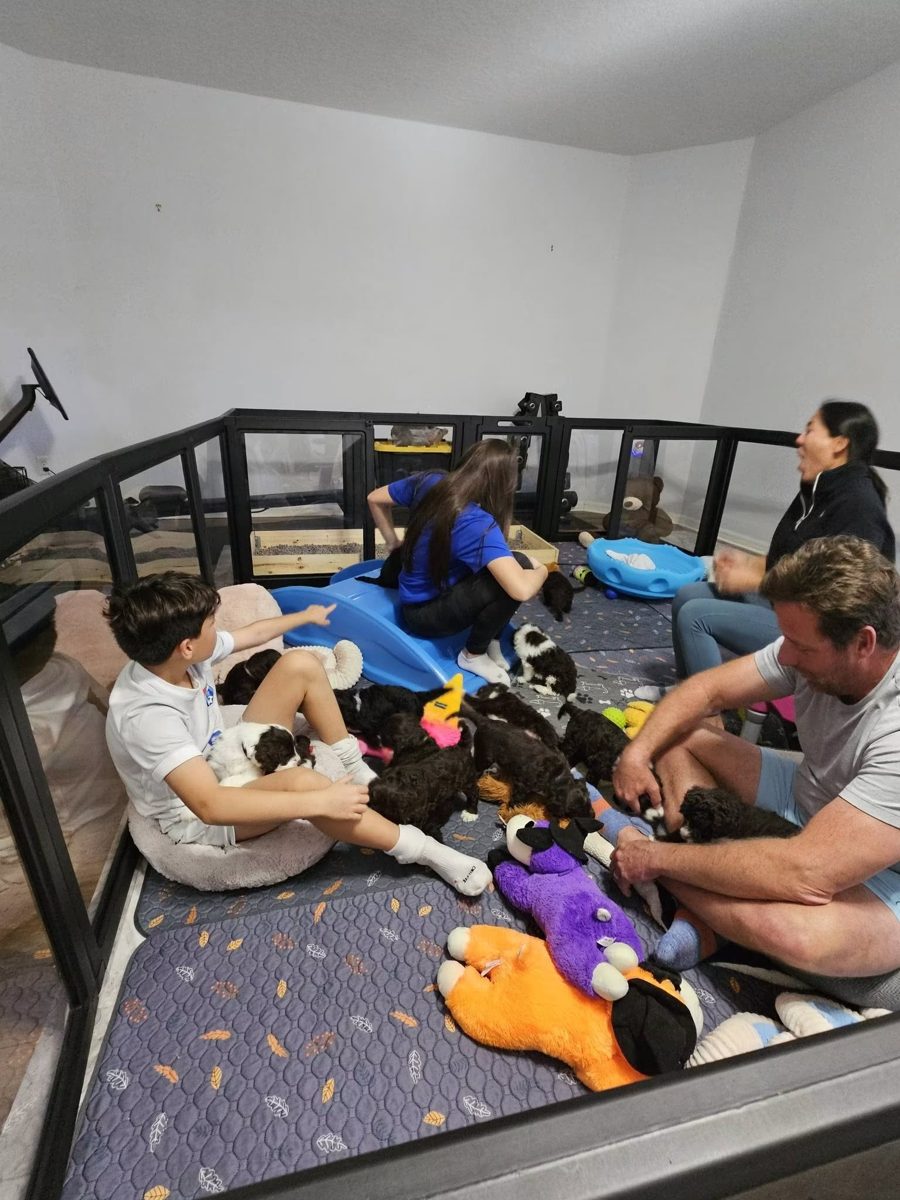 The Martin family playing with a litter of puppies in the puppy room
If this sounds like too much, a PWD is not the breed for you. If it sounds like your kind of dog, start with our recommended reading and the PWDCA.